

468x60 Ads

.
Showing posts with label Capital of India. Show all posts

Monday, November 12, 2012

Delhi : 25 Must See Tourist Destinations

Must-See Architectural Structures in Delhi for Your Indian Vacation

Delhi encapsulates two very distinct worlds - the old and the new. The spacious New Delhi was built as the imperial capital of India by the British while the rambunctious Old Delhi served as the capital of Islamic India. There are 24 must-see architectural sites in Delhi that you can wander around while you are on your Indian vacation. Sunday is the best day to shuttle between attractions. Observe proper dress code when visiting places of worship. Hungry travelers can indulge from meaty curries, rice cakes, to crispy pizzas and sashimi.

1. Rashtrapati Bhawan is the official residence of the president of India. To its west side is the Mughal gardens which occupies an area of 130 hectares. The garden is open for public viewing on some days of February/March. 

The Rashtrapati Bhawan of India


2. India Gate and Rajpath. The India Gate is a 42-m high stone memorial arch built in memory of about 90,000 Indian army soldiers who offered their lives during WWI, the Northwest Frontier operations and 1919 Afghan fiasco. Broad Rajpath hosts the spectacular Republic Day parade every 26 January and the Beating of the Retreat on 29 January.
India Gate


3. Laxminarayan Temple. This temple is located west of Connaught Place. The main temple dedicated to Lakshmi, the goddess of wealth and her consort, Narayan the preserver is known for its soaring domes and Orissan style.

Lakshmi Narayan Temple (Birla Mandir), Delhi

4. Akshardham Temple. Located on Delhi's outskirts, Akshardham temple is recently built structure made of pink sandstone and white marble. This extraordinary temple reflects traditional Orissan, Gujarati, Mughla, and Rajasthani architectural elements and has exquisite domes and pillars.
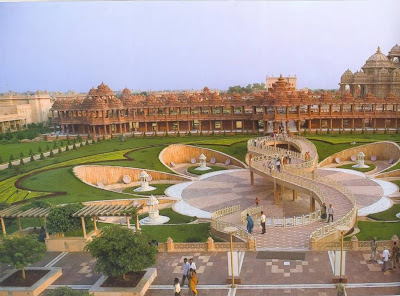
Akshardham Temple - Delhi


5. Gurdwara Bangla Sahib is known for its gold domes and healing powers.

Gurdwara Bangla Sahib -Delhi

6. Humayun's Tomb is must seel tomb for your Indian vacation located at the Mathura Road. This brilliant early Mughal architecture was built in the mid-16th century.

Humayun's Tomb

7. Qutub Minar is the most attractive monument in the Qutub Complex. Read More ...

Qutub Minar


8. Red Fort is a massive fort completed in 1648.

The Red Fort


9. Salimgarh Fort


Salimgarh Fort

10. Chandni Chowk is Old Delhi's famous shopping street. Some shops open from around 10 am to 7 pm.
Chandni Chowk - the most happening place of Delhi


11. Jama Masjid is spectacular with its finely proportioned structure with graceful arches. This was constructed by Ali Adil Shah, the same person responsible for erecting the fortified city walls and the Gagan Mahal.


Jama Masjid Delhi


12. Raj Ghat. Another focus of the Raj-appointed English architect Edwin Lutyens, this structure hosts the spectacular Republic Day and Beating of rh Retreat.

13. Lotus Temple is an eye-catching temple, poetically shaped completed in 1986.

14. Purana Quila is the largest Muslim Camp in Delhi.

15. Tughlaqabad is a walled city and fort built by Ghiyas-ud-in and the saint Nizam-ud-din

16. Yantra Mandir

17. Safdarjung's Tomb

18. Lodhi Gardens is a well-tended garden popular for its crumbling tombs of the Sayyid and Lodi rulers including the 15th century Bara Gumbad.

19. Nizamuddin Dargah is the shrine of the Muslim Sufi saint, Nizam-uddin- Chishti who died in 1325.

20. Sansad Bhavan is a circular building with colonnaded structure of 171 m diameter.

21. National Museum, New Delhi showcases thousands of historic artefacts from the Harappan Civilization, Central Asian antiquities, Indian textiles, tribal masks, sculptures, musical instruments, old coins, miniature paintings and weapons.

22. St. James Church

23. Karim's Restaurant

24. Connaught Place. Your Indian vacation wouldn't be completed without seeing Connaught Place. The structure often creates confusion because of its' outer and inner circle.

Thursday, November 1, 2012

The Qutub Minar of Delhi

Qutub Minar in Delhi

Qutub Minar is the pride of Delhi. The tall minaret was constructed in 1192 by Qutab-ud-din Aibak, and later completed by his successor Iltutmish. The soaring conical tower is an exquisite example of Indo-Islamic Afghan architecture.

Qutub Minar is a World Heritage Site and has survived the ravages of time impressively. The Minar of Delhi is surrounded by a lush green garden, which is an ideal leisurely place for visitors. Qutab Minar is the favourite destination of tourists. It is India's most visited monument attracting around 3.9 million visitors every year.

Qutub minar, delhi
The 5 storied Qutub Minar has 379 steps
Each of the 5 storeys and tower of Qutub Minar has unique designs.

It was hit by lightening couple of times and was damaged. The subsequent rulers repaired it. Thus it is standing mightily as it was before till date.

Qutab Minar is a great masterpiece of Mughal architecture. The base of the Qutub Minar measures 14.32 meters and the top of the structure measures 2.75 meters. The bird eye's view of Delhi city from the top is amazing. The base of first storey has alternate angular and circular flutings, the second one is round. The third storey of the Qutub Minar has angular flutings. The balconies projecting out heighten the beauty of the Minar.

The tower is so high that around 379 steps are needed to be climbed to reach the top. Another taller tower adjacent to Qutub Minar is named Alai Minar which is somewhat tilted in one direction.

The verses from the holy Qur'an are carved on sandstone walls of Qutub Minar. This monument serves the purpose of calling people for prayer in the Quwwat-ul-Islam mosque. This is a tower of victory, a monument that signify the might of Islam, or a tower for keeping a check for defense.


Tourist attractions near Qutub Minar

Qutub Minar has some adjoining structures that lend shine of some of its fame. The Qutub complex houses the iron wonder nearby. The Iron Pillar is one of the metallurgical interests of the world. It is a thing to study as well as famous tourist destination. Traditionally people believe that if anyone standing in front of pillar with his back towards the column can encircle it with their arms, all his wishes will be fulfilled. Government has built a fence around it for safety.

An earthquake damaged top two floors of the minar during the rule of Firoz Shah; but was repaired by Firoz Shah himself. He built marble pavilions here. In the year 1505, earthquake again damaged it and was repaired by Sikandar Lodi. Once again the minar faced earthquake in the year 1794, then Major Smith refurbished the affected parts of the minar and replaced Firoz Shah's pavilion with his own pavilion. This pavilion was again removed in the year 1848 by Lord Hardinge. Now it can be seen lying between the Dak Bungalow and the Minar in the garden.

Many natural conditions weathered the minar but it is still standing with all the might owing to time to time renovations and reinstated and renovated by the respective rulers. 


Humayun's Tomb : A Distinct Example of Mughal Architecture


Humayun's Tomb at Delhi


The Humayun Tomb is one of the important places in tourist map of Delhi. 

History:

Humayun died in 1556, and his widow Hamida Banu Begam, also known as Haji Begam, commenced the construction of his tomb in 1569, fourteen years after his death. It is the first distinct example of proper Mughal style, which was inspired by Persian architecture. It is well known that Humayun picked up the principles of Persian architecture during his exile, and he himself is likely to have planned the tomb, although there is no record to that effect. The tomb was constructed at a cost of 15 lakh rupees (1.5 million).

Mirak Mirza Ghiyath, a Persian, was the architect employed by Haji Begam for this tomb.

Construction, Architecture and Layout:

The tomb proper stands in the centre of a square garden, divided into four main parterres by causeways (charbagh), in the centre of which ran shallow water-channels. The high rubble built enclosure is entered through two lofty double-storeyed gateways on the west and south. A baradari (pavilion) occupies the centre of the eastern wall and a hammam (bath chamber) in the centre of northern wall.

The square red sandstone double-storeyed structure of the mausoleum with chamfered corners rises from a 7-m. high square terrace, raised over a series of cells, which are accessible through, arches on each side. The grave proper in the centre of this cell-complex is reached by a passage on the south. The octagonal central chamber contains the cenotaph, and the diagonal sides lead to corner-chambers which house the graves of other members of the royal family. Externally each side of the tomb, its elevations decorated by marble borders and panels, is dominated by three arched alcoves, the central one being the highest. Over the roof pillared kiosks are disposed around the high emphatic double dome in the centre. The central octagonal chamber contains the cenotaph, encompassed by octagonal chambers at the diagonals and arched lobbies on the sides. Their openings are closed with perforated screens. Each side is dominated by three arches, the central one being the highest. This plan is repeated on the second storey too. The roof surmounted by a double dome (42.5m) of marble has pillared kiosks (chhatris) placed around it.

The Main Entrance of Humayun's Tomb at Delhi


Humayun's Tomb from the inside

 
The mausoleum is a synthesis of Persian architecture and Indian traditions-the former exemplified by the arched alcoves, corridors and the high double dome, and the latter by the kiosks, which give it a pyramidal outline from distance. Although Sikandar Lodi's tomb was the first garden-tomb to be built in India, it is Humayun's tomb which set up a new vogue, the crowning achievement of which is the Taj at Agra. There is also a somewhat common human impetus behind these two edifices-one erected by a devoted wife for her husband and the other by an equally or more devoted husband for his wife.

Several rulers of the Mughal dynasty lie buried here. Bahadur Shah Zafar had taken refuge in this tomb with three princes during the first war of Independence (AD 1857).

The site was chosen on the banks of Yamuna river, due to its proximity to Nizamuddin Dargah, the mausoleum of the celebrated Sufi saint of Delhi, Nizamuddin Auliya, who was much revered by the rulers of Delhi, and whose residence, Chilla Nizamuddin Auliya lies just north-east of the tomb.

Visiting Details:
Open from sunrise to sunset

Entrance Fee:
Citizens of India and visitors of SAARC (Bangladesh, Nepal, Bhutan, Sri Lanka, Pakistan, Maldives and Afghanistan) and BIMSTEC Countries (Bangladesh, Nepal, Bhutan, Sri Lanka, Thailand and Myanmar) - Rs. 10 per head.

Others: US $ 5 or Indian Rs. 250/- per head

(children up to 15 years free)

_______________________________________________* ! * _______________________________________________